


Local SEO helps a landscaping business appear when nearby homeowners search for lawn care, garden design, or patio installation. It improves your visibility in Google Maps, the Map Pack, AI Overviews, and AI tools like ChatGPT and Perplexity.
This guide covers what to fix, in what order, and why each step matters. It is based on what we see when we work with local service businesses at Marvanix.
What Is Local SEO for Landscapers?
Local SEO for landscapers means optimizing your online presence so people in your service area find you first. It covers your Google Business Profile, website, reviews, and local listings. The goal is more calls, quote requests, and direction requests from nearby customers.
Why Does Local SEO Matter for Landscapers?
Landscaping is a local service. A homeowner in your city will not hire someone two states away.
Most of these customers search on their phones and call one of the first three businesses they see. If you are not in the Map Pack, you lose that job before the conversation starts.
Local SEO vs Regular SEO
Regular SEO aims to rank a website nationally or globally. Local SEO aims to rank a business within a specific city or area. For a wider look at SEO beyond your local area, read our guide to SEO for landscapers.
| Factor | Traditional SEO | Local SEO |
|---|---|---|
| Main goal | Website traffic | Calls, visits, and quote requests |
| Keyword style | “landscaping tips” | “landscaper in Austin” |
| Key ranking signals | Backlinks, content quality | Proximity, relevance, prominence |
| Main result area | Organic blue links | Map Pack and Google Maps |
| Most important asset | Website | Google Business Profile |
Google’s Three Local Ranking Factors
Google uses relevance, distance, and prominence to rank local businesses. Relevance is how well your profile matches the search. Distance is how close you are to the searcher. Prominence is how well known and trusted you are, based on reviews, links, and mentions.
You cannot change distance, but you can improve the other two.
Where Do Customers Look for Landscapers Online Today?
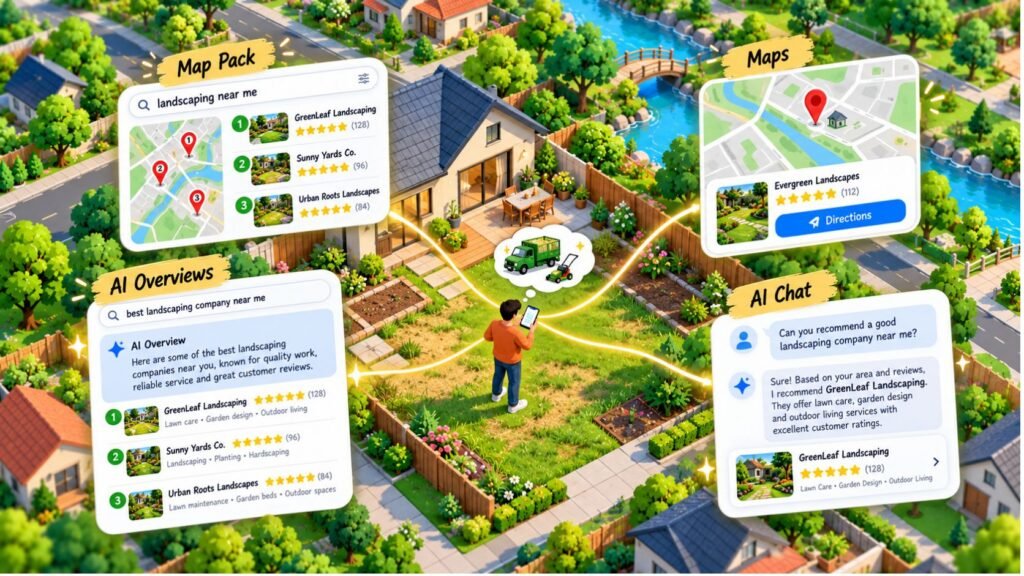
Customers find landscapers through Google Maps, the Map Pack, regular search results, AI Overviews, and AI assistants like ChatGPT and Perplexity. Most searches include a service and a location, or the phrase “near me.” Local intent is strong, and buyers usually contact a business within hours.
What Do People Search For?
Searches usually fall into three groups: service plus city, “near me” searches, and seasonal needs.
Examples include “lawn care in Denver,” “landscapers near me,” and “spring cleanup services.”
How Are AI Tools Changing Local Search?
Google AI Overviews now answer many questions directly on the results page. ChatGPT and Perplexity also recommend local businesses when users ask for the best option nearby.
These tools pull from your Google Business Profile, website, reviews, and mentions on other sites. If that information is clear and consistent, you are more likely to be named.
| Search Type | Example Query | Where It Appears |
|---|---|---|
| Local service | “lawn mowing service in Tampa” | Map Pack |
| Near me | “landscapers near me” | Google Maps |
| Question | “How much does a patio cost?” | AI Overviews |
| Recommendation | “Best landscaper in Dallas?” | ChatGPT, Perplexity |
Why Mobile Search Matters
Most local landscaping searches happen on a phone, often while the homeowner is standing in the yard. They want a number to call or a quote form that works fast.
If your site is slow or hard to use on mobile, they leave and call the next result.
Google Business Profile Optimization for Landscapers
To optimize your Google Business Profile, choose the right primary category, list every service, add real photos, keep your hours accurate, and collect reviews regularly. Your profile is the biggest ranking factor for the Map Pack, so complete every field and update it often.
Which Categories Should You Choose?
Pick “Landscaper” or “Landscape Designer” as your primary category. Add secondary categories only for services you actually offer, such as “Lawn Care Service” or “Garden Center.”
In our experience, the wrong primary category is one of the first things we fix on a new landscaping profile. [Add a real example here: what the category was, what you changed, and what happened to calls or rankings.]
Then list each service separately, with a short description and a price range where possible.
Photos and Posts That Help
Upload real photos of finished projects, your crew, and your equipment. Add before-and-after shots for every major job.
Post updates every week or two. Seasonal offers, completed projects, and short tips all work well.
How Many Reviews Does a Landscaper Need?
There is no fixed number. A steady flow of new reviews matters more than a big total.
Aim for at least one or two new reviews every week. Reply to every review, positive or negative, within a few days.
Setting Your Service Area
List only the cities and neighborhoods you truly serve. Listing too many areas can hurt trust and make your profile look unfocused.
Start with a radius you can cover well, then expand as your business grows.
| GBP Element | What to Do | Impact |
|---|---|---|
| Primary category | Choose “Landscaper” | High |
| Services list | Add every service with details | High |
| Photos | Upload new project photos monthly | Medium |
| Reviews | Request after each completed job | High |
| Posts | Share updates every 1-2 weeks | Medium |
| Business hours | Keep accurate, including holidays | Medium |
| Q&A | Answer common questions yourself | Medium |
Which Local Keywords Bring the Best Landscaping Leads?
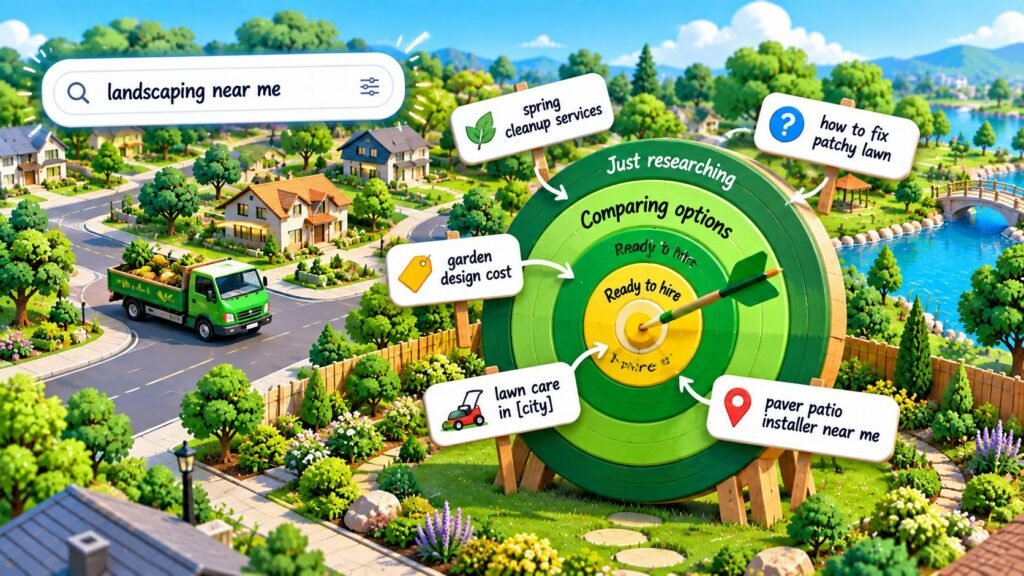
The best local keywords combine a service with a location, such as “lawn care in Phoenix” or “retaining wall contractor near me.” Start with your core services, add every city you serve, and include seasonal terms. Pick keywords that show clear buying intent.
Best Keyword Types
Focus on these types:
- Service + city: “tree trimming in Raleigh”
- Near me: “garden design near me”
- Seasonal: “fall leaf cleanup”
- Problem-based: “fix patchy lawn”
- Question-based: “how much does landscaping cost?”
Targeting Multiple Cities
Create one page per main service area. Each page needs unique content, such as local project photos, neighborhood names, and customer reviews from that area.
Do not copy the same text and swap the city name. Google and AI tools both treat that as thin content.
Free Keyword Research Methods
Start with Google’s autocomplete and the “People also ask” box. Type a service and a city, and note the suggestions.
You can also check Google Search Console to see which queries already bring visitors. Your customers’ own questions on calls and emails are another strong source.
| Service | Example Local Keyword | Search Intent |
|---|---|---|
| Lawn care | “lawn care service in Columbus” | Ready to hire |
| Hardscaping | “paver patio installer near me” | Ready to hire |
| Garden design | “landscape designer in Portland” | Research and hire |
| Tree trimming | “tree trimming cost in Atlanta” | Price research |
| Irrigation | “sprinkler repair near me” | Urgent need |
Website Structure for Local SEO
Your website should have a separate page for each service and each main location, a clear contact section, and your name, address, and phone number on every page. Add local project examples, customer reviews, and an FAQ. This helps both search engines and AI tools understand where you work.
Do You Need Separate Service and Location Pages?
Yes. A single “Services” page cannot rank for every service in every city.
Build individual pages, for example “Paver Patios,” “Lawn Maintenance,” and “Garden Design.” Then add location pages for the cities you serve.
What Should a Service Page Include?
Each page should explain the service, the process, typical pricing, and the areas you cover.
Add real photos, a short FAQ, and one clear call to action. A phone number or quote form should be visible without scrolling.
Local Project Pages
Very important. A project page shows proof of work in a specific neighborhood.
Include the location, the problem, what you did, and the result. These pages build trust and give AI tools concrete details to quote.
Example from our work: [Client type, city, and service, for example “a lawn care company in [City]”]. We [what you did, for example “rebuilt three service pages and added project photos”]. Within [time frame], they saw [result, for example “a 40% rise in calls from Google Business Profile”]. [Only use real, verified numbers.]
Title Tags and Meta Descriptions
Keep the title under 60 characters and include the service and the city. A simple format is “Service + City | Business Name.”
Write the meta description as a short, honest summary with a reason to call, such as free quotes or years of experience.
Does Site Speed Affect Local Rankings?
Slow pages frustrate visitors and raise bounce rates. Compress your project photos, use modern image formats, and avoid heavy plugins.
A page that loads in under three seconds on mobile keeps more visitors and gives search engines a better experience signal.
Why Do Reviews and Citations Matter for Local Trust?
Reviews and citations show Google and AI tools that your business is real, active, and trusted. Reviews prove customer satisfaction. Citations are listings of your business on other sites, and they confirm your details are consistent. Both strengthen your prominence in local results.
Getting More Genuine Reviews
Ask right after finishing a job, when the customer is happiest. Send a direct Google review link by text or email.
Keep the request short and personal. We usually suggest a text message with a direct link, sent the same day the job is finished. Never offer payment or discounts in exchange for reviews, because it breaks Google’s policy.
Responding to Negative Reviews
Reply calmly and quickly. Thank the customer, address the issue, and offer to fix it offline.
Future customers read your replies. A professional response often builds more trust than a perfect rating.
What Is NAP Consistency?
NAP stands for Name, Address, and Phone number. It must be identical everywhere your business is listed.
Even small differences, like “St.” versus “Street,” can confuse search engines. Inconsistent NAP data weakens your rankings and makes AI tools less sure which details are correct.
| Citation Source | Why It Matters |
|---|---|
| Google Business Profile | Main source for Maps and Map Pack |
| Bing Places | Feeds Bing and some AI tools |
| Apple Business Connect | Used in Apple Maps and Siri |
| Yelp | Strong review and trust signal |
| Better Business Bureau | Credibility for service businesses |
| Angi and HomeAdvisor | Common source for home service searches |
| Local chamber of commerce | Local authority and backlink |
Content Marketing for Local SEO
Helpful local content brings in visitors who are not ready to hire yet and builds trust before they are. Blog posts, guides, and project stories answer real homeowner questions. They also give AI tools clear, quotable information about your expertise and your area.
Best Topics to Write About
Write about problems your customers actually have. Good topics include:
- Best grass types for your region
- How much a new patio costs in your city
- When to plant trees and shrubs locally
- How to prepare a yard for winter
- Common drainage problems and fixes
Making Content Locally Relevant
Mention local climate, soil, water rules, and neighborhoods. A guide to “lawn care in Phoenix summers” is more useful and more rankable than a general lawn guide.
Local detail also signals to AI tools that your business knows the area well.
How Often Should You Publish?
One or two quality posts a month is enough for most landscapers. Consistency matters more than volume.
Update older posts each season with fresh prices, photos, and tips.
When Should Landscapers Run Seasonal Campaigns?
Launch seasonal campaigns four to six weeks before demand rises. Spring brings cleanups and planting, summer brings maintenance and irrigation, and fall brings leaf removal and winterizing. Timing your updates around these peaks captures searches when demand is highest.
Preparing Seasonal Pages
Publish or refresh seasonal pages four to six weeks before demand rises. Search engines need time to index and rank them.
For example, update your spring cleanup page in February, not in April.
What Should a Seasonal Offer Include?
Keep it simple. State the service, the area, the time frame, and how to book.
Post the offer on your Google Business Profile and website at the same time.
| Season | Common Services | Content Idea |
|---|---|---|
| Spring | Cleanup, planting, mulching | “Spring lawn checklist for your city” |
| Summer | Mowing, irrigation, pest control | “How to keep your lawn green in heat” |
| Fall | Leaf removal, aeration, overseeding | “Best time to aerate your lawn” |
| Winter | Planning, design, snow services | “Plan your garden design before spring” |
AEO for Landscapers: Answer Engine Optimization
AEO means writing content that answers questions clearly so search engines can show your answer directly. For landscapers, this means using question-based headings, giving short direct answers, adding FAQ sections, and using schema markup. The goal is to appear in featured snippets and AI Overviews.
What Is AEO?
AEO focuses on being the answer, not just a link. When someone asks “How often should I fertilize my lawn?”, an answer engine picks the clearest response it can find.
If your page gives that response in two or three plain sentences, you are a strong candidate.
Writing Content That Wins Snippets
Follow a simple pattern:
- Use the exact question as your heading.
- Answer in 40 to 60 words right below it.
- Add detail after the direct answer.
- Use tables and short lists for comparisons.
Which Schema Markup Should You Use?
Use LocalBusiness schema with your NAP, hours, and service area. Add FAQPage schema for your questions and Service schema for each offering. Review schema can support your ratings where it follows Google’s guidelines.
Voice Search Tips
Voice searches are longer and sound like real speech, such as “Who is the best landscaper near me?” Use natural phrasing in your headings and answers.
Keep answers short, because voice assistants usually read only one or two sentences.
| AEO Tactic | Example | Benefit |
|---|---|---|
| Question headings | “How much does lawn care cost?” | Matches real searches |
| 40-60 word answers | Direct reply under each heading | Easy for engines to extract |
| FAQ section | 5 common customer questions | Wins snippets |
| Tables | Price or service comparisons | Clear data for AI |
| Schema markup | LocalBusiness, FAQPage | Better understanding |
GEO for Landscapers: Generative Engine Optimization
GEO means making your business easy for AI tools like ChatGPT, Gemini, and Perplexity to understand, trust, and recommend. You do this with clear entity information, consistent mentions across the web, strong reviews, and helpful local content. AI tools recommend businesses they can verify from multiple sources.
What Is GEO?
Generative engines write answers instead of listing links. A user might ask, “Who is a reliable landscaper in Nashville?” and get a short list of names.
If you are not mentioned, you do not exist for that customer. GEO helps you get on that list.
Getting Mentioned in ChatGPT and Perplexity
Keep your business details identical across your website, Google Business Profile, and directories.
Publish specific content, such as pricing guides, service area pages, and project case studies. Get mentioned on local news sites, community blogs, and trusted directories. AI tools lean on sources they can cross-check.
Entities and Local Authority
An entity is a clearly defined thing, like your business, your owner, or your service area. AI tools connect these entities to build trust.
Use the same business name, describe your services consistently, and link your site to your profiles. Strong reviews and local mentions add authority.
Testing Your AI Mentions
Ask ChatGPT, Gemini, and Perplexity local questions once a month. Try “best landscaper in [your city]” and “who offers paver patios near [your area].”
Note whether you appear, which competitors are named, and which sources the tools cite. Use those gaps to guide your next updates.
| Factor | AEO | GEO |
|---|---|---|
| Main focus | Direct answers in search | Mentions in AI-written answers |
| Main platforms | Google snippets, AI Overviews | ChatGPT, Gemini, Perplexity |
| Content style | Short, structured answers | Clear, factual, well-sourced content |
| Key action | Question headings and schema | Consistent entity data and mentions |
| Success signal | Featured snippet or AI Overview | Business named in AI responses |
Do Local Backlinks Help Landscapers?
Yes, they do. Local backlinks are links from nearby websites to yours, and they tell Google and AI tools that your business is part of the community. A few relevant local links often matter more than many random ones.
Where to Get Local Backlinks
Look for natural opportunities close to home:
- Local chamber of commerce and business associations
- Sponsorships of schools, sports teams, or community events
- Supplier and manufacturer partner pages
- Local news features and neighborhood blogs
- Home builders, realtors, and interior designers you work with
Does Social Media Help Local SEO?
Social media does not directly raise rankings, but it supports your visibility. Sharing project photos builds brand recognition and drives branded searches.
It also creates more mentions of your business across the web, which helps AI tools confirm you exist and are active.
Which Local SEO Results Should You Track?
Track phone calls, direction requests, website form submissions, Map Pack rankings, and review growth. Use Google Business Profile Insights, Google Analytics, and Search Console. Also test AI tools monthly by asking local questions to see whether your business is mentioned.
Metrics That Matter Most
Rankings are useful, but leads matter more. Watch these numbers:
- Calls from your Google Business Profile
- Direction requests
- Quote form submissions
- New reviews per month
- Branded and local search impressions
How Long Does Local SEO Take to Work?
Most landscapers see early movement in 6 to 12 weeks. Strong, steady results usually take 4 to 6 months.
Competition and your starting point change this. Consistent work beats quick fixes.
Tracking Phone Calls
Use a call tracking number on your website and keep your main number on your Google Business Profile. Also ask every new customer how they found you.
This shows which channel actually brings paying jobs, not just clicks.
6 Local SEO Mistakes Landscapers Make
The most common mistakes are choosing the wrong categories, using inconsistent NAP details, ignoring reviews, and building thin location pages. Many landscapers also forget to track results, so they cannot tell what works.
- Using a wrong or too many Google Business Profile categories
- Listing different phone numbers or addresses across sites
- Leaving reviews without replies
- Copying the same page for every city
- Skipping photos and project proof
- Not tracking calls and leads
Frequently Asked Questions
How much does local SEO cost for a landscaper?
Most small landscaping businesses spend between $500 and $2,000 per month with an agency. Doing it yourself costs time but little money. You can see what we include on our Landscaper SEO services page, or contact us for a quote based on your service area and goals.
Can a small landscaping company rank without a big budget?
Yes. A complete Google Business Profile, steady reviews, and useful local pages can beat larger competitors in your area.
Is Google Business Profile enough on its own?
No. It drives most Map Pack visibility, but a strong website, citations, and reviews support it and help AI tools trust you.
Do AI search tools recommend local landscapers?
Yes. ChatGPT, Gemini, and Perplexity can name local businesses. They rely on reviews, listings, and website content to decide who to mention.
How often should I update my profile and website?
Update your profile weekly or biweekly with posts and photos. Review your website content every few months, and refresh service pages each season. We review our clients’ pages at the start of every season.
Do I need a website if I have a Google Business Profile?
Yes. Your website gives search engines and AI tools deeper information about your services, pricing, and area. It also gives customers a place to see proof of your work.
What Should Landscapers Do First?
Start with three steps:
- Complete and verify your Google Business Profile.
- Create one strong page for each core service and city.
- Ask every happy customer for a review.
Once these are in place, add schema, fix your citations, and publish helpful question-based content.
If you want help putting this plan to work, our team at Marvanix offers landscaper SEO services built around your services and your city, including local SEO, AEO, and GEO. Contact us to talk through your goals, or read more in our guide to SEO for landscapers.