

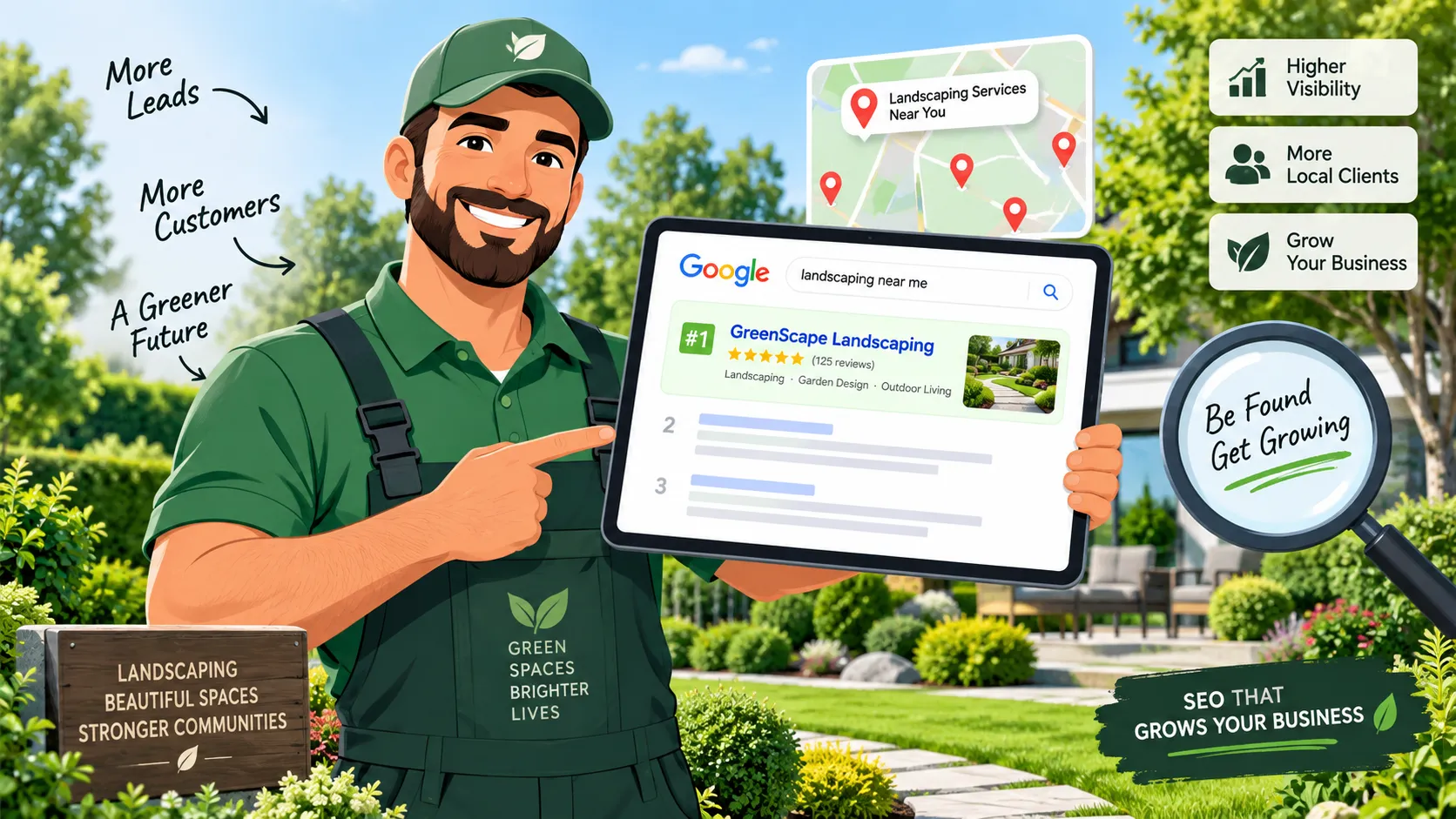
Most landscaping companies don’t lose work because their crews are worse. They lose it because the homeowner never saw them in the search results.
Every spring, thousands of property owners open Google, type something like “landscaper near me” or “lawn care company in [city],” and pick from whatever shows up in the first few results.
If your business isn’t one of them, it doesn’t matter how good your hardscaping is. You’re invisible to the exact customer who was ready to hire someone today.
This guide breaks down exactly how SEO works for landscaping companies: what it costs, how long it takes, how to structure your website, and the mistakes that quietly kill rankings.
No fluff, no theory you can’t use tomorrow morning.
What Is SEO for Landscapers?
SEO for landscapers is the process of optimizing a landscaping company’s website, Google Business Profile, and online content so it ranks higher in search results for the services it offers and the areas it serves. Done well, it turns “landscaper near me” searches into phone calls and quote requests without paying for every single click.
The market backs this up. The U.S. landscaping services industry generated an estimated $188.8 billion in 2025 across roughly 692,777 businesses.
And no single company controls more than about 5% of that market. That means visibility, not size, decides who wins the customer in your zip code.
Key Takeaways
- A complete, active Google Business Profile is the single highest-leverage SEO asset for most landscaping companies.
- Local searches convert fast: roughly three-quarters of “near me” mobile searches lead to a visit or contact within 24 hours.
- Most landscaping businesses spend $500-$3,000 per month on SEO, with meaningful rankings taking 6-12 months.
- Duplicate city pages, thin content, and inconsistent business listings are the most common self-inflicted ranking problems.
- AI Overviews now touch roughly 1 in 5 searches, but the content that wins there is the same specific, well-structured content that wins in classic SEO.
Across small businesses generally, an estimated 58% still haven’t optimized for local search at all , which means the bar for standing out in a given service area is often lower than most landscaping owners assume.
What Is SEO for Landscapers (and How Does Google Decide Who Ranks)?
SEO, or search engine optimization, is the practice of making a website and its supporting online presence easier for Google to understand, trust, and rank for relevant searches.
For a landscaping business, that means showing up when someone searches for mowing, hardscaping, irrigation, or landscape design in your service area.
Google decides rankings using three broad signals: relevance (does your content actually match what the searcher wants), proximity (how close your business is to the searcher), and prominence (how well-known and well-reviewed your business is, both online and off).
Here’s the part most landscaping owners miss. Google treats “SEO” and “local SEO” as two overlapping but distinct games:
- Organic SEO: ranking your website in the standard blue-link results for keywords like “landscape design ideas” or “how much does a paver patio cost.”
- Local SEO: ranking your Google Business Profile in the map pack (the three businesses shown with a map at the top of local searches).
Most landscaping leads come from the map pack, not the standard organic listings. That single fact should shape almost everything you invest in first.
Here’s the quick side-by-side:
| Organic SEO | Local SEO | |
|---|---|---|
| Where it shows up | Standard blue-link results | Map pack + Google Maps |
| Best for | Informational content, cost guides, design ideas | “Near me” and service+city searches |
| Main input | Content quality, backlinks, site structure | Google Business Profile, reviews, citations |
| Typical landscaping ROI | Slower, long-term brand and lead building | Faster, direct-response phone calls and quote requests |
Most landscaping companies should weight their early effort toward local SEO, then layer organic content on top once the fundamentals are in place.
The demand for this kind of visibility keeps growing.
About 8 in 10 U.S. consumers search for a local business every week, and roughly 3 in 10 do it every single day.
Near-me searches specifically have grown by roughly 400% since 2020 as more people search from their phones while already thinking about a project.
How Can Landscapers Improve Their Google Visibility With SEO?
Improving visibility isn’t one task. It’s a handful of connected pieces that reinforce each other. Skip one and the rest work harder for less reward.
Google Business Profile Optimization
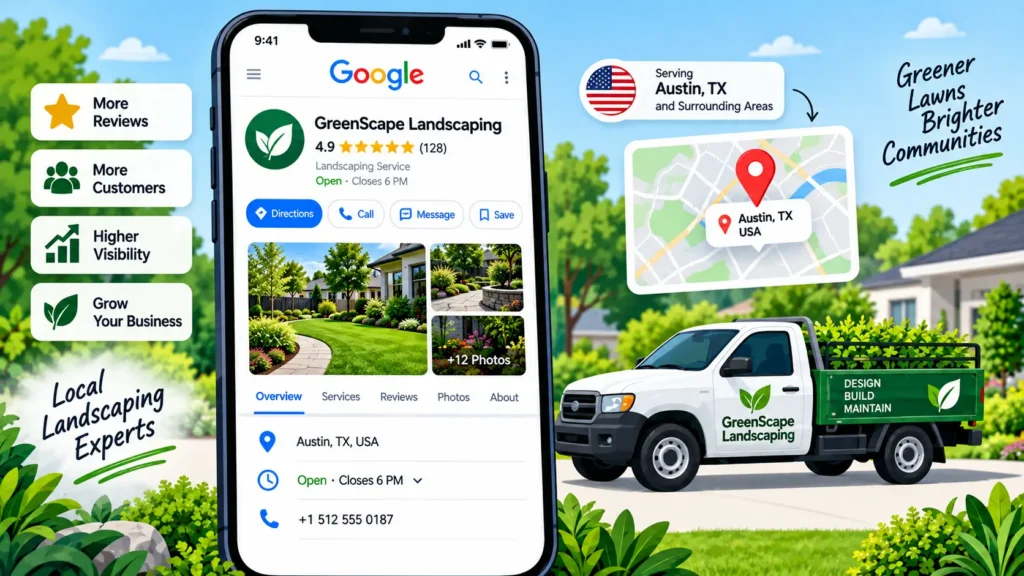
Your Google Business Profile (GBP) is the single highest-leverage asset you have.
It’s free, it’s what shows up in the map pack, and it’s often the first thing a homeowner sees before they ever visit your website.
A complete, active profile isn’t optional anymore.
Businesses with a fully filled-out GBP get roughly 7x more clicks than incomplete ones, and customers are 2.7 times more likely to consider a business reputable when its profile is complete on Search and Maps (Google Business Profile Help).
To get a GBP working for you:
- Claim and verify the listing under your legal business name. Never stuff keywords into the name field, since Google penalizes this.
- Pick accurate primary and secondary categories (“Landscaper,” “Lawn care service,” “Landscape designer”) that match what you actually do.
- List every service you offer with a short, specific description, not just “landscaping services.”
- Add photos constantly: before/after shots, crews on-site, finished hardscaping. Profiles with more photos get more calls and direction requests.
- Set your service area precisely if you travel to customers rather than operating from a storefront.
- Post updates weekly, such as seasonal promotions, recent projects, or tips, to signal an active, trustworthy business.
Reviews sit inside this same category, and they carry enormous weight.
A listing with 40 or more reviews and a 4.5-star average shows up in the local 3-pack roughly 3.7 times more often than one with fewer than 10 reviews.
And adding a single full star to your average rating can lift revenue for a local business by 5% to 9%.
Not a single one of those numbers happens by accident. Ask for the review the day the job finishes, while the work is still fresh in the customer’s mind.
Send the review link directly by text, not just email. Text messages get opened within minutes, while emails sit unread for days.
A simple two-line message with a direct link converts far better than a generic “please review us” ask buried in an invoice.
Keyword Research for Landscaping Businesses
Keyword research is figuring out exactly what your customers type into Google before they hire someone, then building your site around those specific words.
Landscaping keywords fall into three intent buckets, and confusing them is where most companies waste content budget:
- Transactional: the searcher is ready to hire (“landscaping company near me,” “hire a landscaper in [city]”). These convert fastest and should map to your homepage and service pages.
- Commercial investigation: the searcher is comparing options (“best landscaping company in [city],” “landscaper vs lawn care service”). These belong on comparison and review-driven content.
- Informational: the searcher is researching, not yet buying (“how to design a backyard patio,” “when to aerate a lawn”). These belong on blog content that earns trust and internal links back to your service pages.
Here’s what the actual mix of terms looks like for a typical landscaping business:
| Keyword | Search Intent | Best Page Type |
|---|---|---|
| landscaping company [city] | Transactional | Service/location page |
| lawn mowing service near me | Transactional | Service page |
| best landscaper in [city] | Commercial | Comparison/reviews page |
| paver patio cost | Commercial | Pricing blog post |
| how often should I water new sod | Informational | Blog post |
High-intent, low-competition local terms are worth more to your bottom line than a single high-volume national keyword you’ll never realistically outrank a franchise for.
Use Google Search Console, Google’s own autocomplete and “People also ask” boxes, and free tools like Google Keyword Planner or Ubersuggest to find the exact phrasing your local customers use.
It’s rarely the generic industry term you’d expect.
Don’t ignore long-tail phrases just because the search volume looks small on paper.
“Drought-tolerant landscaping for clay soil in [city]” might get searched twenty times a month, but the person typing it is far closer to hiring than someone searching plain “landscaping.”
Ten of those searches converting into calls will outperform a thousand visits from a broad term that never becomes a lead.
On-Page SEO for Landscaping Websites
On-page SEO is everything you control directly on a page to help it rank: titles, headings, content, images, and internal links.
The essentials for every service and location page:
- Title tag that includes the service and city (“Landscape Design in Austin, TX | [Company Name]”), kept under roughly 60 characters.
- One H1 per page matching search intent, followed by a clean H2/H3 hierarchy.
- Unique, specific content. Never duplicate the same paragraph across three city pages with only the city name swapped. Google notices, and so do customers.
- Descriptive image alt text (“crew installing paver patio in [city] backyard”) instead of generic file names.
- Internal links connecting related service pages, blog posts, and location pages to each other.
- A clear call-to-action above the fold: a phone number and quote form, not buried at the bottom.
None of this is exotic. It’s the difference between a page Google can confidently match to a search and one it has to guess about.
A quick self-test: read your service page out loud. If it could describe any landscaping company in any city, it needs more specifics: actual project examples, real materials you use, real turnaround times.
Generic copy ranks generically, if it ranks at all.
Local SEO for Landscapers
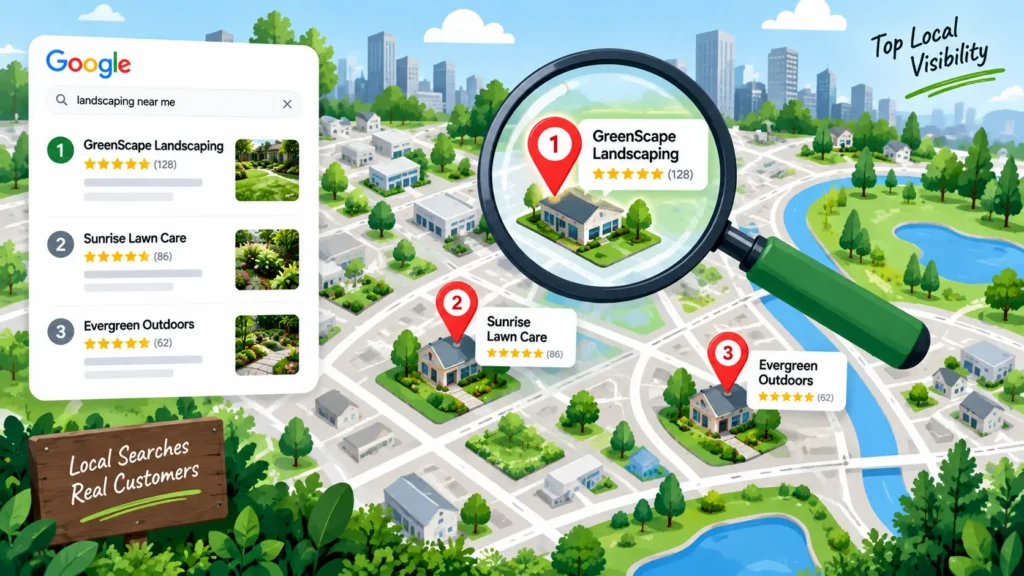
Local SEO is the layer that tells Google exactly where you operate and who trusts you there. It sits on top of everything above.
Three pieces matter most:
- NAP consistency: your Name, Address, and Phone number must match exactly across your website, Google Business Profile, Yelp, Angi, Houzz, and every other directory. Inconsistent listings actively confuse Google’s confidence in your location.
- Local citations: get listed in home-service directories (Houzz, Angi, Thumbtack, HomeAdvisor, local chamber of commerce sites) with consistent NAP data.
- Local link building: earn backlinks from local news coverage, community sponsorships, supplier partnerships, or industry associations in your area.
Roughly 46% of all Google searches now carry local intent.
And businesses ranking in the top three map pack positions capture 126% more traffic and 93% more calls, clicks, and direction requests than those ranked four through ten.
That gap is the entire business case for local SEO.
Don’t overlook link building closer to home, either.
A mention from a local newspaper covering a community beautification project you sponsored, or a backlink from a supplier’s “find a contractor” page, tends to carry more local ranking weight than a generic guest post from an unrelated national site.
Content Marketing for Landscaping SEO
Content marketing is how you earn the informational searches: the ones happening months before someone is ready to hire, when you can plant your name early.
The formats that consistently work for landscaping businesses:
- Seasonal maintenance guides (“Spring Lawn Care Checklist for [Region]”)
- Project cost breakdowns (“How Much Does a Retaining Wall Cost in [City]”)
- Design inspiration and before/after project galleries
- Plant and material guides suited to your climate zone
- FAQ-style posts answering the exact questions customers ask on the phone
This content does double duty. It attracts informational searches now, and it’s increasingly what AI tools pull from when they answer landscaping questions directly inside search results (more on that below).
Aim for one useful piece per month rather than four thin ones.
A single, thorough guide to choosing between sod and hydroseeding for your climate will outperform four short, generic posts that all say roughly the same thing without answering anything specific.
Technical SEO for Landscaping Websites
Technical SEO is the plumbing behind the site: invisible to visitors, but it decides whether Google can crawl, understand, and trust your pages at all.
The non-negotiables:
- Mobile-friendliness: the majority of local searches now happen on a phone, and Google indexes the mobile version of your site first.
- Page speed: slow-loading galleries of high-resolution project photos are one of the most common landscaping-site problems; compress images before uploading.
- HTTPS/SSL: a basic trust signal Google expects from every site.
- Clean URL structure: /services/paver-patios beats /page?id=482.
- Schema markup: LocalBusiness and Service schema help Google (and AI tools) understand exactly what you do and where.
- No broken links or duplicate pages: both waste crawl budget and dilute ranking signals.
Most landscaping websites are built on WordPress, Wix, or a home-services-specific platform, and none of these guarantee good technical SEO out of the box.
Run your site through Google’s PageSpeed Insights and Mobile-Friendly Test at least once a quarter, especially after adding new project galleries.
AI Search and Answer Engine Optimization for Landscapers
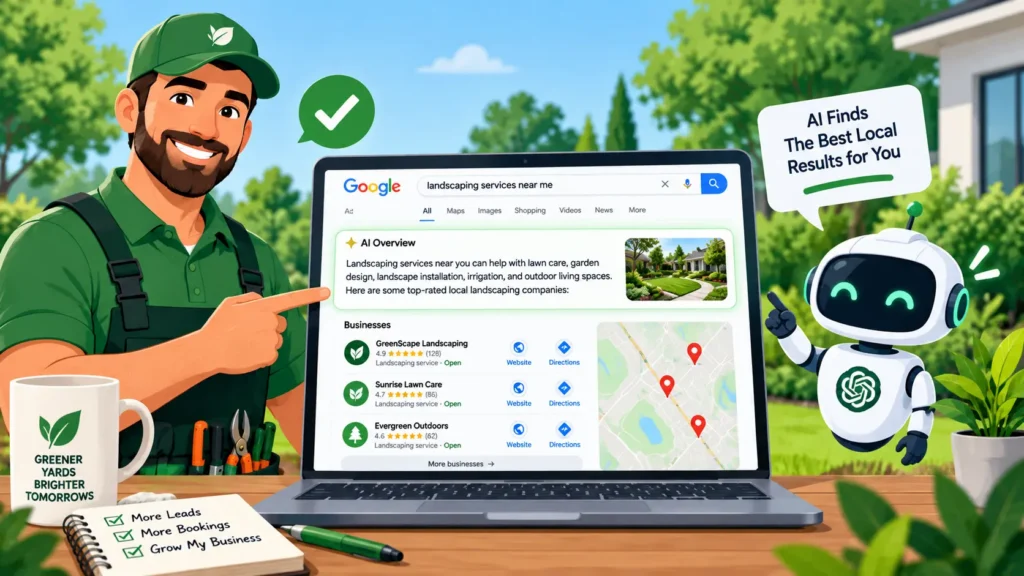
Search itself is changing shape.
Google’s AI Overviews now appear on more than 20% of all searches, and industry-wide, organic click-through rates drop sharply whenever an AI summary appears above the results, in some studies by more than half.
That’s not a reason to panic. It’s a reason to write clearer, more specific content.
The pages AI tools pull from tend to share a few traits: they answer the question directly in the first sentence, they include concrete numbers, and they’re structured with clear headings AI can extract cleanly.
Research on generative-engine optimization tactics found that adding specific statistics, credible citations, and clear, authoritative language can lift visibility inside AI-generated answers by up to 40%.
Practically, this means:
- Answer the core question in the first 1-2 sentences of every page and blog post.
- Use FAQ sections with direct, complete answers.
- Keep your Google Business Profile and website facts perfectly consistent; AI tools cross-reference both.
- Don’t abandon traditional SEO for this. The overlap between classic SEO and AI-search optimization runs close to 80%, so the fundamentals above still carry the weight.
Mostly what changes here is the writing habit, not the strategy. Lead every section with the direct answer, then support it.
The same structure that helps a rushed homeowner also helps an AI system extract a clean, quotable answer from your page.
How to Measure Landscaping SEO Success
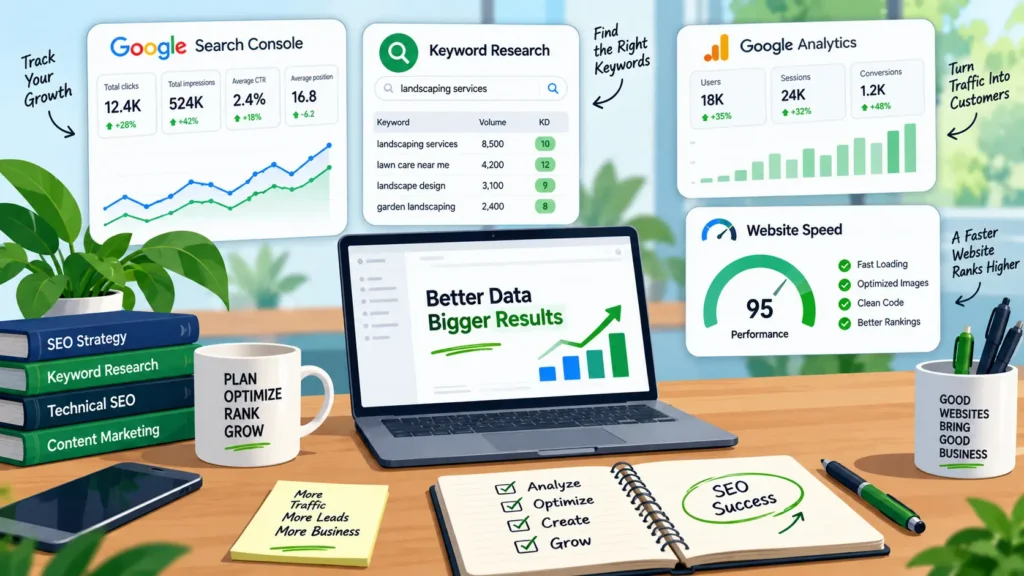
You can’t manage what you don’t track. At minimum, watch these monthly:
- Google Business Profile insights: calls, direction requests, website clicks, and photo views
- Map pack ranking for your top 10-15 service + city keyword combinations
- Organic website traffic and which pages bring in leads (Google Search Console + Analytics)
- Lead and quote form submissions tied back to organic vs. paid vs. referral sources
- Review count and average rating over time
Rankings alone mean nothing if they don’t turn into booked jobs. Track the whole funnel, not just the position.
Essential SEO Tools for Landscapers
You don’t need a dozen subscriptions running to do this well. A handful of tools cover almost everything a landscaping business needs to track and improve.
| Tool | Purpose | Typical Cost |
|---|---|---|
| Google Business Profile | Manage your listing, reviews, and local performance insights | Free |
| Google Search Console | Track rankings, indexing issues, and real search queries | Free |
| Google Analytics (GA4) | Measure website traffic and lead conversions by source | Free |
| Google Keyword Planner | Research keyword search volume and competition | Free |
| Ubersuggest | Find local keyword ideas and content opportunities | Free-$40/mo |
| BrightLocal or Whitespark | Build citations and track map pack rankings by city | $29-$50+/mo |
| Semrush or Ahrefs | Full site audits, backlink tracking, competitor research | $99+/mo |
| Google PageSpeed Insights | Test site speed and mobile-friendliness | Free |
| CallRail | Track which phone calls come from which marketing channel | $45+/mo |
How Should a Landscaping Website Be Structured for SEO?
Structure decides whether Google (and your customers) can find what they need in two clicks or eight. Get this wrong and even great content underperforms.
Service Pages
Every distinct service, such as lawn care, landscape design, hardscaping, irrigation, and snow removal, needs its own dedicated page, not a shared paragraph on a general “Services” page.
Each page should explain the service, show real project photos, list what’s included, and end with a clear call-to-action.
Location Pages
If you serve multiple towns or a metro area, build a dedicated page per major city or service area, each with locally specific content, not a copy-pasted template with the city name swapped out.
Mention local landmarks, climate considerations, or neighborhoods you’ve worked in.
A location page earns its place when it could only apply to that town. If you could delete the city name and the page would still make sense, rewrite it before publishing.
Blog / Resource Content
This is where informational keywords, seasonal guides, and cost breakdowns live.
It’s also your best long-term asset for earning links and AI-search citations, since it answers the questions homeowners ask before they’re ready to buy.
Project and Case Study Pages
Real before/after project pages, ideally organized by service and location, do double duty: they build trust with human visitors and give Google fresh, specific, hard-to-duplicate content that generic competitors can’t easily copy.
Internal Linking Structure
Tie it all together. Blog posts should link to the relevant service page. Service pages should link to related location pages. Location pages should link to a few relevant project examples.
This structure tells Google what matters most on your site and keeps visitors moving toward a quote request instead of bouncing after one page.
How to Create Content That Generates Landscaping Leads
Content only earns its keep if it moves someone from “researching” to “requesting a quote.” These five categories do that reliably.
Seasonal Content
Homeowners think in seasons, and so should your content calendar.
Spring cleanup, summer irrigation, fall leaf removal, and winter snow contracts each deserve their own timely post published a few weeks ahead of demand, not the week everyone’s already searching.
Local Content
Content that mentions your specific service area by name, such as soil types, climate quirks, HOA rules, or common local pests, signals relevance that a national competitor’s generic blog post can’t match.
Cost and Pricing Content
“How much does X cost” is one of the highest-intent searches a homeowner runs before hiring.
Give real ranges, explain what drives the price up or down, and you’ll out-rank vaguer competitors while pre-qualifying leads who are comfortable with your pricing tier.
Customer Question Content
Every question a customer has ever asked you on a sales call is a blog post. “Do I need a permit for a retaining wall?” “How long does sod take to root?”
These are exactly the specific, direct-answer pages that both Google and AI Overviews favor.
Project-Based Content
Turn every finished job into a short case study: the problem, the solution, the result, with photos.
This is unique content no competitor can duplicate, and it’s persuasive in a way generic service copy never is.
How Much Does SEO for Landscapers Cost?
There’s no single number, but there is a reliable range.
Most local businesses, landscaping included, spend between $500 and $3,000 per month on local SEO, with plenty of small operators starting closer to $500-$1,200 and multi-location or highly competitive markets running $2,000-$5,000+.
Automated, listing-only packages sit at the low end ($300-$500/month), while full-service campaigns covering content, technical work, and link building command the higher range.
Here’s roughly how that breaks down by service scope:
| Service Level | Typical Monthly Cost | What’s Included |
|---|---|---|
| Listings/citations only | $300-$500 | Directory accuracy, basic NAP cleanup |
| Small-scale local SEO | $500-$1,200 | GBP management, on-page fixes, light content |
| Full-service program | $1,500-$3,000 | Content, technical SEO, link building, reporting |
| Multi-location/competitive markets | $2,000-$5,000+ | All of the above across several service areas |
Set up as a table, this is easy to scan when you’re comparing agency proposals that use different labels for similar work.
What Affects Landscaping SEO Pricing?
- Market competition: a landscaper in a dense suburb competing against a dozen established companies pays more than one in a smaller town with little competition.
- Number of locations served or physical offices.
- Scope of work: GBP-only management costs far less than a full program covering content, technical SEO, and link building.
- Website condition: a site needing a rebuild adds a one-time cost on top of ongoing SEO.
How Long Does Landscaping SEO Take?
Expect the first meaningful movement, better map pack visibility for a handful of terms, within 3 to 4 months.
Real, durable ranking gains for competitive service+city keywords typically take 6 to 12 months of consistent work. Anyone promising page-one rankings in two weeks is selling something other than SEO.
How to Measure SEO ROI
Compare the cost per lead from SEO against your other channels.
Paid local ads for landscaping currently run around $104 per lead on average, dropping to roughly $40-$50 during the spring peak.
SEO leads, once rankings mature, typically cost meaningfully less per lead over time because you stop paying per click for the same visibility.
Track cost-per-lead and lead-to-close rate by source monthly, not just rankings.
Common SEO Mistakes Landscaping Companies Make
Most of these aren’t complicated to fix. They’re just easy to overlook when you’re busy running crews.
If any of the following sound familiar, that’s usually good news: it means the fix is within reach, not a rebuild from scratch.
- Targeting Only High-Volume Keywords: chasing “landscaping” nationally instead of “landscaping company in [your actual town]”
- Keyword Stuffing: repeating the same phrase unnaturally instead of writing for the reader; Google’s algorithms flag this instantly
- Thin or Generic Content: a two-sentence “Services” page that says nothing a competitor’s page doesn’t already say
- Duplicate Location Pages: the same paragraph with only the city name changed across ten “location” pages
- Ignoring Search Intent: writing a blog post when the searcher actually wanted a service page with a phone number
- Publishing Low-Value AI Content: unedited AI-generated pages with no real project details, photos, or local specifics
- Inconsistent Business Information: different phone numbers or addresses across your website, GBP, and directory listings
- Ignoring Google Business Profile: treating it as a one-time setup instead of a living asset that needs weekly attention
- Focusing on Rankings Instead of Leads: celebrating a #1 position for a keyword that never converts into a phone call
FAQs About SEO for Landscapers
Is SEO worth it for landscaping companies?
Yes, SEO can be worth it for landscaping companies because it helps you reach local customers who are already searching for landscaping services. A good SEO strategy can increase your Google visibility, bring more website visitors, and generate more calls and quote requests over time.
How long does landscaping SEO take?
Early movement typically shows up in 3-4 months, with meaningful, durable results for competitive keywords taking 6-12 months of consistent work.
How much does landscaping SEO cost?
Most landscaping businesses spend $500-$3,000 per month, depending on market competition, number of locations, and the scope of services included.
What keywords should landscapers target?
A mix of transactional service+city terms (“landscaping company in [city]”), commercial comparison terms, and informational content around costs, seasonal care, and design ideas, weighted toward the transactional terms that map to your service pages.
How do landscapers rank on Google Maps?
By fully optimizing and actively maintaining a Google Business Profile, keeping NAP data consistent everywhere it appears online, earning a steady flow of recent reviews, and building local citations and backlinks.
Do landscapers need a blog?
Yes. A blog captures research-stage customers, builds the kind of authority signals Google and AI Overviews reward, and wins searches your service pages can’t answer directly.
Should landscapers create city pages?
Yes, for every distinct town or service area with meaningful search volume, but only with unique, locally specific content. Duplicate city pages do more harm than having no city pages at all.
Can AI content rank for landscaping keywords?
Yes, AI-assisted content can rank for landscaping keywords, but simply generating content with AI does not guarantee rankings. The content should be useful, accurate, original, and written for real customers. Adding real project examples, local knowledge, photos, and expert insights can make the content more valuable and trustworthy.
Ready to Get More Landscaping Leads From Google?
None of this needs to happen all at once. Start with your Google Business Profile this week: it’s free, it’s fast, and it’s usually the single highest-return fix available.
Then move to your top three service pages, then your city pages, then a steady drip of blog content.
If you’d rather have this done for you, get a free SEO audit from Marvanix.
Conclusion
For landscapers, SEO is a compounding asset, not a one-time project. Every review, every optimized page, and every piece of content you publish keeps working long after you’ve moved on to the next job.
Start with the fundamentals above, stay consistent through a full season, and the map pack position you’re chasing becomes the one your competitors are chasing instead.